

Inside Live Wire’s creative system: presentations as bold as their work



Live Wire Productions builds the audio-visual experiences for Formula One hospitality, major concert tours, and large-scale brand activations. Think dynamic lighting that reacts to live action, transparent LED layered for depth, hidden speakers, and full-wall projection mapping. For Ben Hope, Head of Creative, the challenge is selling those experiences to clients before they exist. That means every presentation has to feel as bold as the work itself.
Previously, Live Wire project managers each created their own decks in static design tools. Moving to Adobe software helped, but the presentations still couldn’t keep up with what the team was building. “There’s only so much you can get across with a flat, static deck,” Ben says. The hook wasn’t obvious, the delivery fell short, and clients struggled to imagine what they were being sold.
Live Wire needed something that could grab people with dynamic content. “In our industry,” Ben says, “you need to capture attention straight away.” They needed video playing inside the deck, not hiding behind a link to a YouTube channel. Motion graphics, 3D renders, and animations visible on the slide, right where they belonged.
They found it in Pitch.
Building a brand system that runs itself
When Ben joined Live Wire, he was given an opportunity many creative leads never get: building a brand system the whole company could easily access and use.

While the full brand guidelines are a robust 60-page document, Ben set up a pitch room for each brand and sub-brand. Each room holds the relevant guidelines at the right level of depth, and links straight through to the Drive folder where logos, letterheads, brand variations, and font install files live.
The improvement was immediate. “When I shared the new brand guidelines, I didn’t get anybody asking me where anything was,” Ben says. “They just clicked the links in our pitch room and found exactly what they were looking for.”
“In our industry, you need to capture attention straight away.”
For a creative team that takes brand seriously, this matters. AI has made passable slides easy for anyone to produce, which means standing out is more important than ever. It comes down to showcasing a real brand identity, slide by slide, deck after deck.
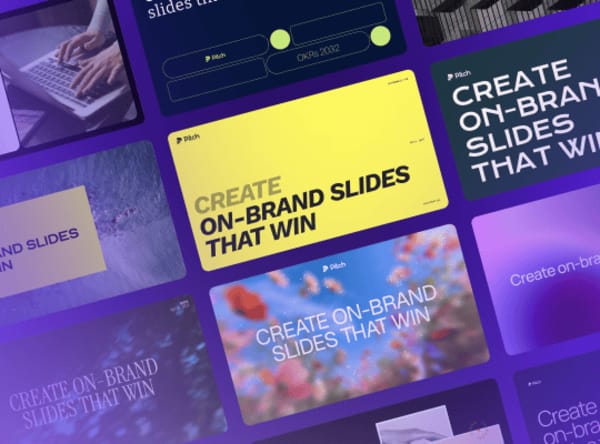
Pitch is built for that. It offers brand-locked templates, structured asset libraries, and the depth a designer expects without the open-endedness that breaks consistency the moment a second person gets involved.
Collaboration at the speed of work
Most presentations at Live Wire start from a template. Each event format and sub-brand has its own, with brand assets, layouts, and structure already in place. That gets the team most of the way there.
Then they move fast. Ben builds a deck skeleton, dropping in placeholder content with guiding comments slide by slide: visuals to update, copy to fix. A colleague follows behind him, filling the slides and tidying alignment as he goes. Motion designers, 3D visualizers, and other specialists get tagged for specific slides and add their pieces directly.
There’s no packaging files and uploading to Drive. No missing fonts when someone’s on vacation. No hunting for the latest version. Pitch’s collaboration capabilities pull a multi-disciplinary creative team into one workspace, which is exactly what video-heavy decks need. Assets that lose their impact the moment they’re moved between tools or exported to flat formats can finally live where they belong: inside the slide, playing at full quality.
Confidentiality without the folder anxiety
When you’re working with competing F1 teams simultaneously, confidentiality isn’t optional. Live Wire’s internal teams are each assigned to a specific F1 client, and none of them should be seeing each other’s work. Teamspaces, Pitch’s access-controlled environments where content is visible only to invited members, solved this. After setting up the team structure and allocating access, anyone working on a project now sees only what they’re cleared for.
“Unlike Google Drive, they can’t see folders and click to request access,” Ben says. “Teamspaces mean that if it’s not visible, it doesn’t exist, and everything runs more smoothly. That’s the genius part.”
Older drive setups create office politics: I can see the folder exists, so why can’t I get in? Teamspaces removes the question entirely. For any creative team handling confidential work across competing clients, the ability to make sensitive work invisible is everything.
An intuitive workspace for creative teams
The Live Wire team’s initial resistance to shifting from Adobe was real. “Unsurprisingly, a room full of designers rolled their eyes at another tool to learn,” Ben says. But it didn’t last long. “Even the old-school designers are fully on board now. Pitch has made their lives and jobs so much easier.”
His advice to anyone weighing up the move: “Don't let your designer ego get in the way and think, ‘I’m a purist that must use Adobe.’ If you’re considering Pitch, go for it. It will save you so much time and effort on your projects. It’s really easy to use and to get your head around.”
“If you’re considering Pitch, go for it. It will save you so much time and effort.”
Live Wire built a creative system in Pitch because the work demanded it. Their presentations need to feel like the experiences they sell, uphold a brand standard worth putting your name to, and scale across a multidisciplinary team working under tight client confidentiality. None of that runs on slides alone. It runs on a workspace built for the way creative teams actually work.
For any team whose reputation rides on visual standards, that’s the bar to look for.
Want to know more about Pitch? Take a product tour, or feel free to reach out.
Spread the word